Species Care & Behaviour

Encouraging Your Bird to Use the Seed Cube

By Russell Neale, Founder, Seed Cube Updated 11 August 2026 9 min read

TL;DR

  • Your bird can see the food. Stepping inside an enclosed space is the hard part, not seeing in.
  • Live with the Cube on the bench for a few days before it goes anywhere near the cage.
  • Add a perch at the opening so they can walk to it instead of flying at it.
  • Never remove their other food to force the switch.
  • Most birds take 2 to 7 days. Cautious birds take 2 to 4 weeks, and that is normal.

Quick answer

Introduce the Seed Cube slowly and never force it. Keep it on the bench where your bird watches you handle it, then move it to the cage and mount it outside empty. Add a perch at the opening so your bird can walk to it rather than fly at it. Then add favourite foods, then their own bowl, and only remove the old bowl once you are certain they are eating inside. Most birds switch in 2 to 7 days. Cautious and rescue birds can take 2 to 4 weeks, which is completely normal.
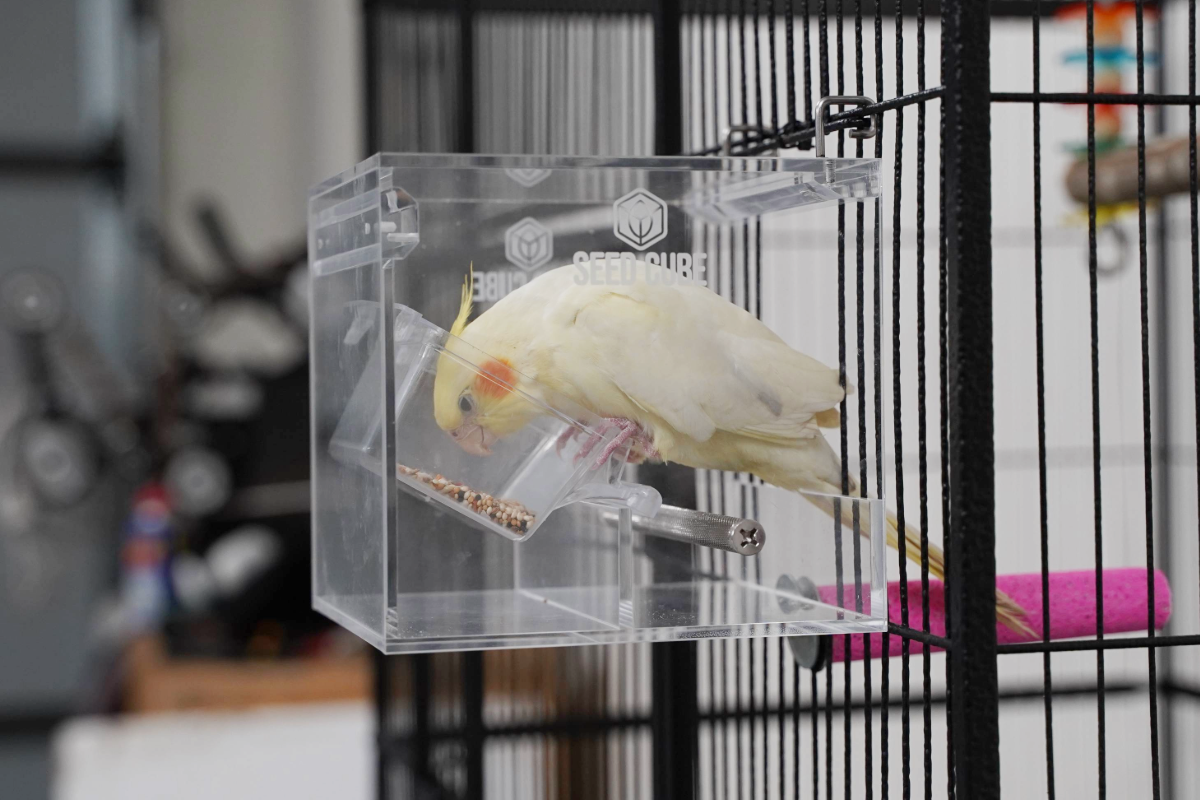
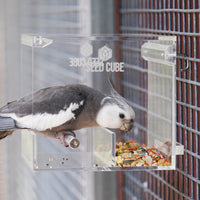
Cockatiel perched at the opening of a clear acrylic Seed Cube bird feeder mounted on a cage
A calm, no-force way to introduce the Seed Cube, at your bird's pace.

Why your bird is hesitating when it can clearly see the food

Here is the part that frustrates people most. Your bird can see the seed. It is right there through the clear acrylic, in plain view, and they still will not go in.

Seeing the food was never the problem. Stepping inside something is.

A bird will happily eat from an open dish in the middle of a room. Asking it to put its body into an enclosed space with one way out is a completely different request, and clear walls do not change that. Parrots are prey animals. Every instinct they have says keep your exits open and do not commit to a space you have not checked.

So your bird is not being stubborn, and you have not bought the wrong feeder. They are running the same risk assessment their species has run for millions of years. Your job is to make the answer obvious, and that takes a few days where very little appears to happen.
What progress actually looks like

Most people measure the wrong thing. They watch for their bird to eat a full meal inside the Cube, see nothing by day three, and decide it has not worked. Plenty have it back in the box by the weekend.

That is going to the gym three times and asking why you have not lost any weight. Nothing has failed. You are just early.

Eating inside is the last step, not the first. Here is what counts before that.

  • Turning to look at it instead of turning away
  • Staying relaxed on the perch nearest to it
  • Stepping toward it, even one step
  • Standing at the opening without going in
  • Putting the head in and taking it straight back out
  • One seed. Just one.

Every one of those is progress. If your bird looked at it today and did not move away, that was a good day.

Step 1: Live with it before you feed from it

Do not mount it yet. Do not put it in the cage. For the first few days the Seed Cube is just another object in the room, and that is exactly what you want.

Put it where your bird already spends time and already feels safe.

  • On the bench while you prep their food. Every day, in view. They watch you handle it, and you are the safest thing in their world.
  • Near the play stand or play gym, not shut in a cupboard between attempts.
  • On the table where they sit with you.

Pick it up. Move it around. Wipe it down in front of them. Birds pay close attention to what their person touches, and an object you handle calmly every day stops reading as a threat.

If your bird comes out of the cage, let them climb on it and chew it. Investigating on their own terms is the entire point. The Cube should be boring before it is ever useful.

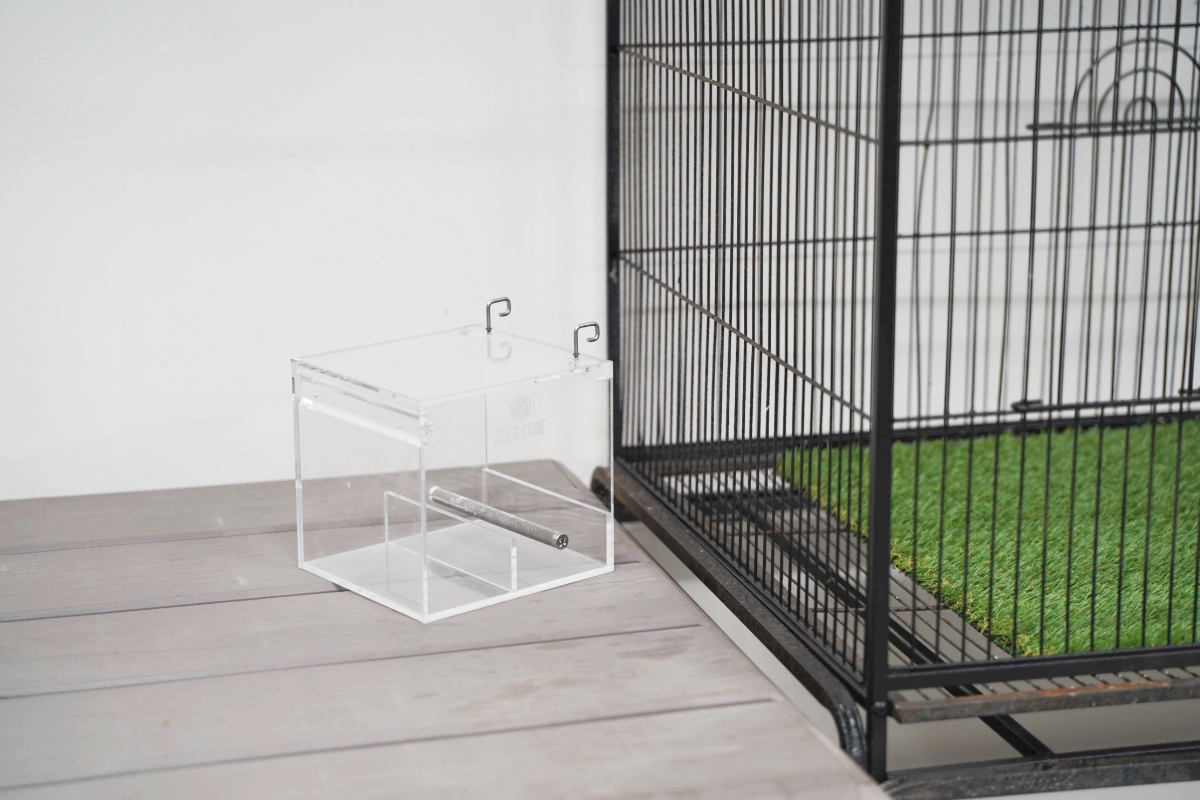
Seed Cube placed on a bench near a bird cage for first familiarisation
Seed Cube placed on a bench near the cage during the first familiarisation stage.

Step 2: Move it to the cage, then mount it outside empty

Once they ignore it on the bench, start closing the gap. Move it a little nearer the cage each day until it touches the bars. If your bird tenses or shifts to the far side, you have gone too fast. Take it back to where they were relaxed and hold there for another two days.

Then mount it on the outside of the cage and leave it completely empty.

This step catches people out because nothing appears to happen. That is the point. You are not feeding from it yet. You are proving it is part of the furniture, it does not move, and it never does anything unpleasant. An empty Cube your bird has stopped noticing is a win.

Give it three to five days here. If you are unsure about hooks or positioning, the installation guide covers both the standard hooks and the Talon-Hook safety hooks.

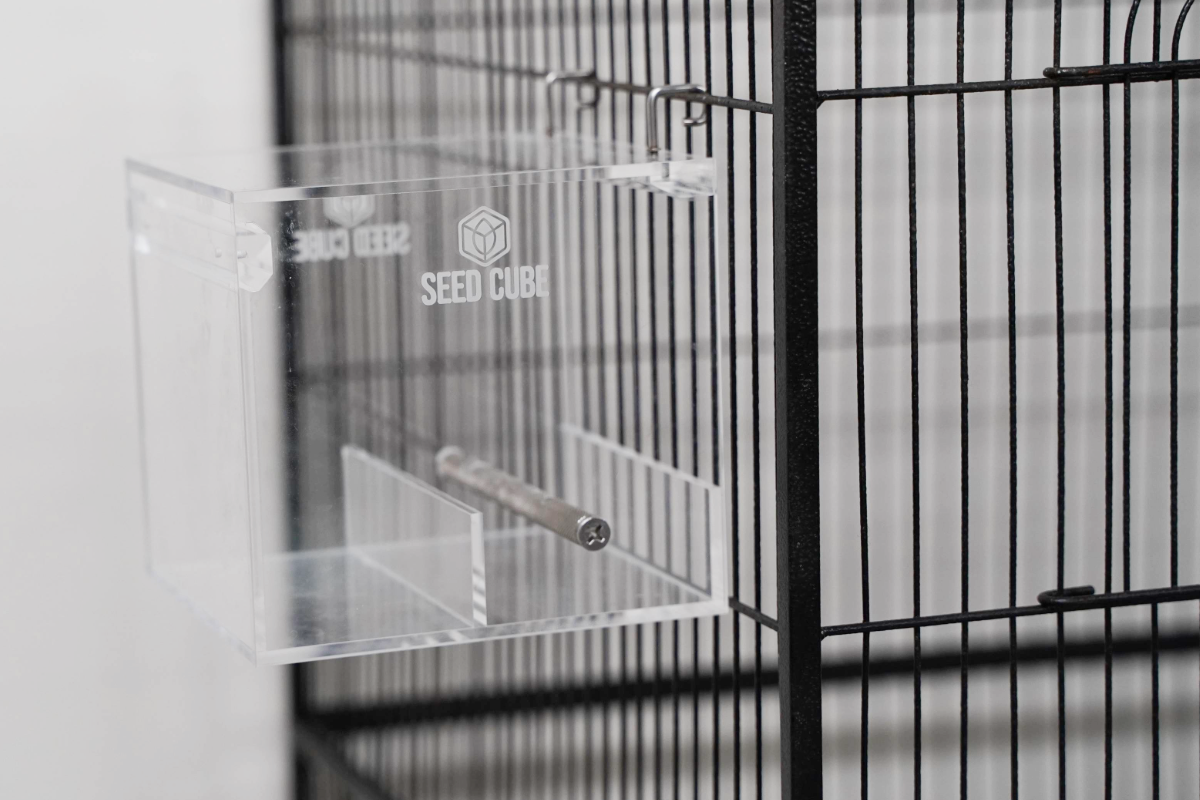
Seed Cube mounted empty on the outside of a cage to build trust
Seed Cube mounted empty outside the cage to build trust before adding food.

Step 3: Give them a way to walk to it, not fly at it

This is the step almost everyone skips, and it does more work than the rest combined.

Look at how your bird would actually reach the Cube right now. If the nearest perch is a wingbeat away, you are asking a nervous bird to launch across the cage and land accurately on one small perch, against a clear panel that gives it very little visual edge to judge. That is a leap of faith. Most birds simply refuse it, and the ones that do try it are the ones that misjudge, get a fright, and set the whole process back.

Give them a walkway instead. Position a cage perch so your bird can side-step along and arrive at the opening on foot.

  • Set it level with the opening or just below, so they look up and in rather than down into it.
  • Leave enough clearance that a full tail swings past without brushing the Cube.
  • Use a natural branch or rope perch if you have one. More grip than dowel, and more confidence on the approach.
  • Make sure they can sit there and look inside without stepping in. Looking from a safe spot is the first real win.

A bird that can walk to the opening will investigate it days earlier than one that has to fly to it.

Step 4: Add favourite foods, and leave the old bowl exactly where it is

Now put something worth having inside. Not their dinner. A few of the things they would cross the cage for, whether that is millet, a piece of walnut, a favourite pellet or a bit of corn.

Scatter a little at the opening as well as inside, so the first taste does not require full commitment.

The old bowl stays. Same place, same food, same amount. There is no pressure to switch and no reason to panic. If your bird eats nothing from the Cube for a week, they are still eating properly, and that is the only thing that actually matters.

If you are refreshing their mix as well, do that separately and later. One change at a time. Forage Gourmet Seed and Vetafarm are worth exploring once the feeder itself is settled.

Step 5: Put their own bowl inside, and check they are really eating

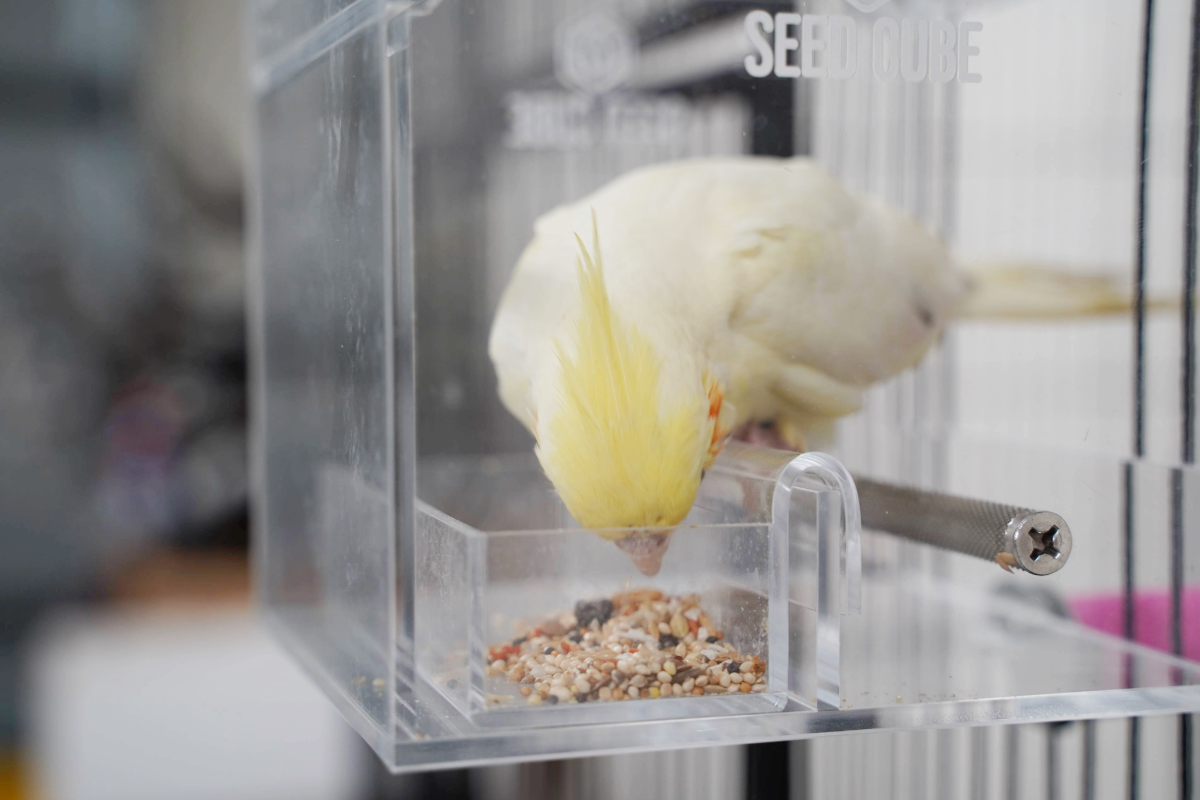
When your bird is comfortably taking food from around the opening, move their actual bowl inside the Cube. Same bowl, same food. Angle it so it is easy to reach from the perch.

This is usually the moment it clicks. Everything familiar is now in the new place, and the only thing that has changed is the walls around it.

Keep the outside bowl for a few more days. Then reduce what is in it rather than removing it. Half, then a quarter, then empty but still there. The bowl itself comes out last.

Cockatiel eating from a familiar bowl placed inside a Seed Cube during transition
Cockatiel eating from a familiar bowl placed inside the Seed Cube during transition.

Step 6: Make the full switch, with or without the Easy-Tray

Once your bird eats from the bowl inside without hesitating, take the bowl out and fill the feeding area directly. Most birds do not blink at this. They decided the Cube was safe a while ago, and the bowl was only ever a bridge.

From here you can run the Cube on its own, or drop in an Easy-Tray.

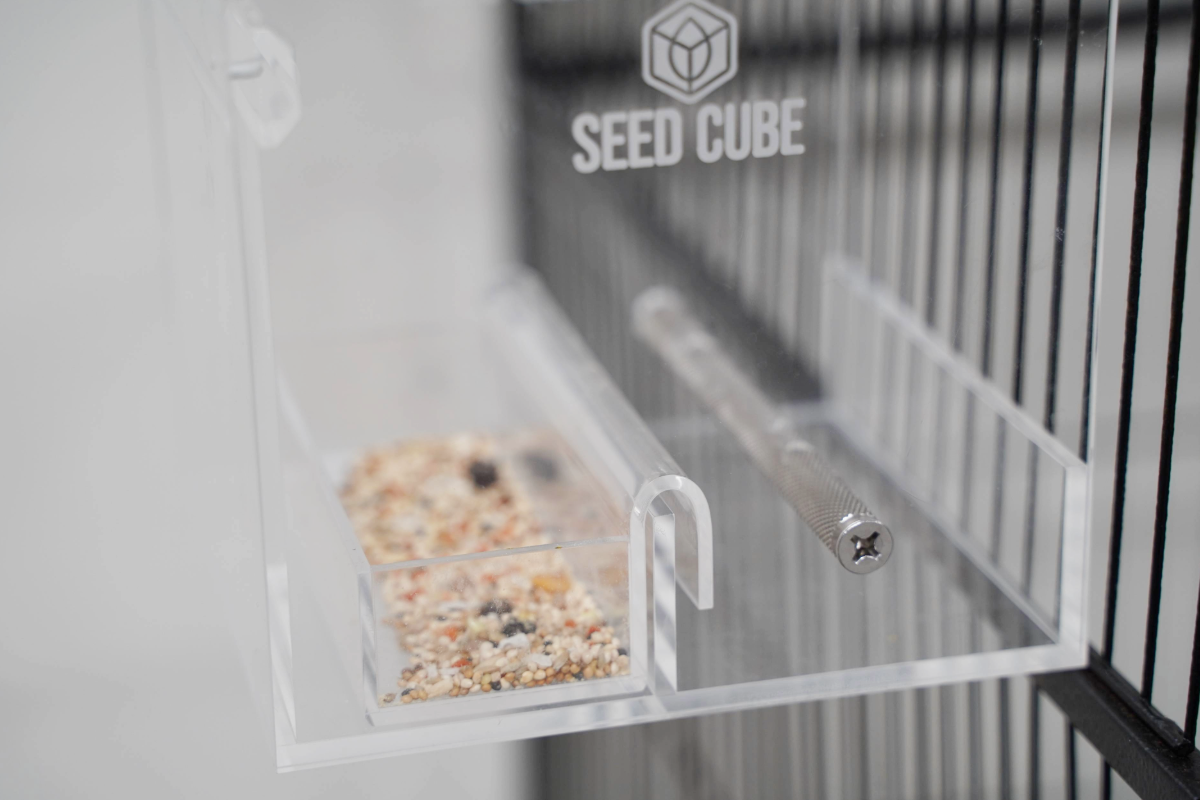
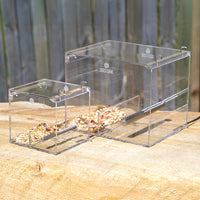
Small Easy-Tray: holds wet mixes, chopped veg and fruit in one place, and slides in and out so you can change food fast and rinse it clean. Clear, bird-safe acrylic in a compact shape that keeps as much feeding space as possible.

Large Easy-Tray: a removable insert for the Large Seed Cube that keeps seed and fresh foods contained, with a purpose-built fit that does not wobble. Hand wash or rinse in warm water, and avoid harsh chemicals or high heat.

Choose the Small Easy-Tray or the Large Easy-Tray to match your Cube. If you are still deciding on size, the size guide matches your bird to the right one.

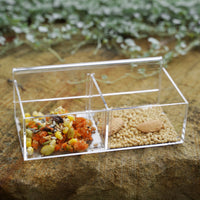
Seed Cube with an Easy-Tray insert holding familiar food for clean feeding
Seed Cube with an Easy-Tray insert holding familiar food for clean feeding.

When it stalls, and what to do

Most transitions stall at least once. Almost none of them stall permanently. Find yours below.

They only use it when I leave the room. That is a bird being sensible, not a problem. Keep leaving the room. Confidence with an audience comes later.

They used it for a few days, then stopped. Something changed. Check whether the food went stale, the Cube shifted, or something new appeared nearby. Fix the change and they usually resume within a day or two.

One bird uses it, the other will not. Let the confident one demonstrate. Flock birds learn by watching, and a hesitant bird will often follow a cage mate into a space it would never try alone.

They chew it instead of eating from it. Common with galahs and cockatoos, and it is investigation rather than rejection. Beak-first is how they assess anything new. Let them.

They pull food out and drop it. They are carrying it somewhere they consider safer. That is progress, not failure, and it usually settles once the Cube feels secure.

They had a fright near it and now avoid it. Go back two steps, not one. Take it off the cage entirely, return it to the bench for a week, and rebuild from there. Rushing this is what turns a setback into a lasting aversion.

Nothing at all after four weeks. Check the basics. Is there a perch they can walk along to reach it. Is it at chest height. Is it rock solid when they land on it. A feeder that shifts under a bird's weight gets refused every time.

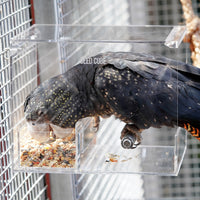
Cockatiel feeding happily inside a Seed Cube after a full transition
Cockatiel feeding happily inside the Seed Cube after a full transition.

Key facts

  • 2 to 7 days

    Typical transition time

  • 2 to 4 weeks

    Normal for a cautious bird

  • At the opening

    Add a perch they can walk to

  • Keep the old bowl

    Until they are eating inside

Cleaner feedingSmall Easy-Tray-Bird Feeder-Seed Cube

Make the switch easier

Small Easy-Tray

$19.99

The Easy-Tray drops into your Seed Cube and keeps wet mix, veg and fruit in one place, then slides out for a quick rinse. It makes the transition tidier and daily clean-up faster.

Shop the Easy-Tray
Small Easy-Tray-Bird Feeder-Seed Cube
Small Easy-Tray $19.99
Shop the Easy-Tray

Frequently asked questions

How long will it take my bird to use the Seed Cube?

Confident birds often begin within 2 to 5 days. Very frightened birds can take 2 to 4 weeks using the near-cage and external-mounting steps.

Can I speed it up by taking the other food away?

No, and this is the one thing that can genuinely harm your bird. Small birds have very high metabolic rates and cannot skip meals the way a dog or a cat can. Lafeber notes that budgies should not go more than 8 to 10 hours without food. Removing the familiar bowl to force a switch risks your bird eating nothing at all, and it teaches them the new object is connected to going hungry. Keep the old bowl until you have confirmed they are eating from the Cube.

Should I remove other bowls straight away?

No. Keep the normal bowl until your bird eats from the bowl placed inside the Cube. Remove it during the final step.

Does the Seed Cube have a door my bird has to get through?

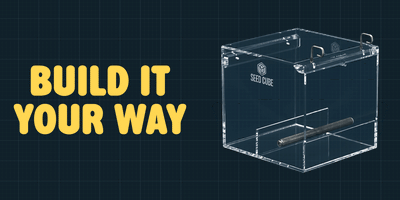
No. There is no door and nothing closes behind them. It is an open front with a hood over the top, and the acrylic is clear, so your bird can see in and out the whole time. The hesitation is about entering an enclosed space, not about being shut in.

Where should I mount it first?

Start on the outside, empty, to build trust. When ready, move it inside at chest height so entry feels natural.

Do some species take longer than others?

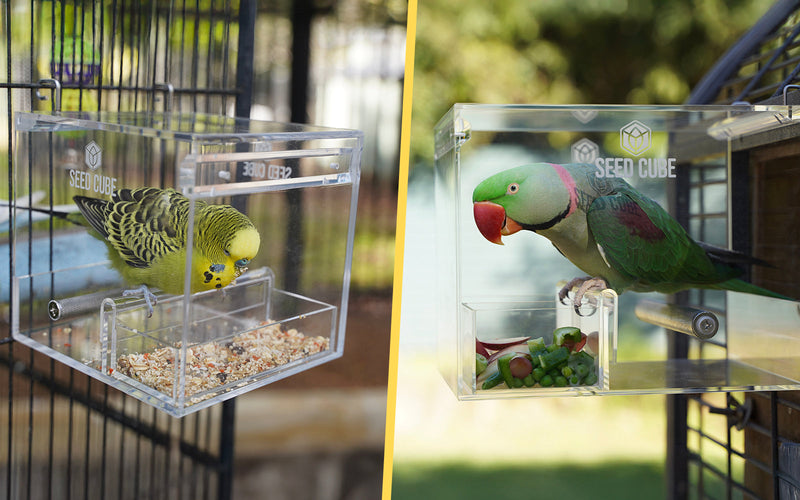
Yes. Conures and Alexandrines are often bold enough to investigate on day one. Lorikeets are usually quick because they are strongly food motivated. Budgies and cockatiels are cautious on their own but follow a confident cage mate readily. Galahs and cockatoos investigate with the beak first, so expect chewing before eating. Finches are the most flighty and benefit most from a perch they can walk along to reach the opening.

My bird has only ever eaten from an open dish. Is that a problem?

Not a problem, just a longer runway. A bird that has never had to enter anything to eat has no reason to think it is safe, so give the early steps more time and do not skip the bench stage. Placing their own familiar dish inside the Cube matters more for these birds than for any other, because it keeps one thing constant while everything around it changes.

Is it strong enough for large parrots?

The Large Seed Cube is built from 4mm UV-stable acrylic with a knurled 304 grade stainless steel perch and stainless bolts. It ships with two hook sets, the standard universal pair and the Talon-Hook safety pair, both 304 stainless, designed to stop the feeder being dislodged by a determined beak. If you are matching a specific species to a size, check the size guide.

When should I use the Easy-Tray?

Use it for fresh foods and faster daily clean-ups. Choose Small or Large to match your Seed Cube.

What if my bird is extremely fearful?

Take it even slower. Some rescue or particularly anxious birds need 2 to 4 weeks just for familiarisation. Cover the Cube with a light cloth at first if needed, then gradually remove it.

Sources

  1. Lafeber Company, Converting Your Bird to a Healthy DietWeight monitoring on a gram scale during a diet conversion, the 10 per cent body weight threshold for contacting a vet, dropping consistency and colour checks, and the guidance that small birds such as budgies should not go 8 to 10 hours without food.

About the author

Russell Neale
Founder, Seed Cube

Russell Neale is the founder of Seed Cube, a bird-feeding brand he started in 2024 in the Hills District of NSW. A long-time bird owner himself, with three birds including a 12-year-old hand-raised Alexandrine, Russell built Seed Cube after years of frustration with messy, flimsy and poorly designed feeders.

Seed Cube makes practical, durable products that keep feeding cleaner, easier and safer for pet birds, and that are designed to last rather than end up in landfill. The brand works closely with Hills Wildlife Sanctuary, and everything it makes is BUILT FOR BIRDS™.

Go at your bird's pace, not the calendar's. Let them live with it before it goes on the cage, give them a perch they can walk along to reach it, keep their old bowl until you are sure they are eating, and never force the issue. Do that and most birds are feeding happily inside within a week or two.

Shop Seed Cube feeders