

Chloe Davies
Chloe Davies

"Super easy to grow. Fresh greens in days. Birds love it and it cuts down waste."

Micropod Build & Balance Microgreens-Microgreens-Seed Cube
Micropod Mustard Seed Kit-Microgreens-Seed Cube
In stock - ships from Sydney

Grow Fresh Microgreens for Balanced Nutrition

Mild pak choi and bold mustard microgreens for advanced enrichment

Food Safe Materials Safe for you and your birds
Grow in Days Fast, visible results
Easy to Grow No experience needed
Ships within 24 hours From Sydney

All orders ship within 24 business hours of being placed.

Australia

  • QLD, NSW, VIC: 1–6 business days
  • TAS, SA, WA, NT: 3–14 business days
  • 0–7.6kg: flat rate $11.99
  • 7.7–20kg: flat rate $16.00
  • Free shipping on orders over $240
  • Delivered with Australia Post

Express (Australia)

  • Generally arrives in 1–3 business days
  • Rates calculated at checkout based on your location
  • Delivered with Australia Post

New Zealand

Two delivery options available at checkout.

Weight Standard6–12 days Express3–7 days
0–0.5kg $10.95 $16.95
0.51–1kg $12.95 $18.95
1.01–1.5kg $14.95 $21.95
1.51–2kg $16.95 $22.95
2.01–3kg $17.95 $24.95
3.01–5kg $27.95 $34.95
5.01–10kg $66.82 $71.77
10.01–20kg $132.94 $136.79

United States All duties included

All duties & tariffs prepaid for a smooth delivery. Choose Standard or Express at checkout.

Weight Standard10–20 days Express3–7 days
0–0.5kg $14.95 $34.95
0.51–1kg $22.95 $39.95
1.01–1.5kg $28.95 $52.95
1.51–2kg $37.95 $57.95
2.01–3kg $41.95 $59.95
3.01–5kg $67.95 $84.95
5.01–10kg $129.95 $137.95
10.01–15kg $174.95 $189.95
15.01–20kg $219.95 $234.95
20.01–30kg $349.95 $374.95
  • Experienced bird owners wanting controlled flavor complexity
  • All parrot species with preference for medium to large birds
  • Best for: galahs, cockatoos, macaws, large amazons, African greys
  • Use with caution in small birds and budgies with thyroid sensitivities
  • Dual-use: humans and birds (pak choi for gentle dishes, mustard for bold accents)
  • 6x compostable jute grow mats (100% plant-based fibre, fully compostable)
  • 3x Pak Choi seed packets (untreated, non-GMO, approximately 1,000 seeds per packet)
  • 3x Mustard seed packets (untreated, non-GMO, approximately 1,000 seeds per packet)
  • No additional soil or chemicals needed
  • Everything needed for six complete growing cycles (equal rotation of both varieties)
  • Sow: Spread seeds evenly across moistened jute mat, cover lightly with another mat
  • Water: Mist daily with water bottle or spray; keep mat moist but not waterlogged
  • Light: Place on windowsill or under grow light; 12-16 hours daily ideal
  • Temperature: Optimal 18-24°C; below 12°C growth stalls, above 25°C seeds may cook
  • Harvest: 8-12 days for both varieties depending on temperature and light
  • Cut just above mat surface with scissors or Micropod Micro Snips
  • For birds: Advanced protocol required. Start with pak choi only to establish acceptance
  • Pak choi serving sizes: Small birds (1-2 tsp), medium parrots (1-2 Tbsp), large parrots (2-4 Tbsp)
  • Once accepted, introduce tiny amounts of mustard mixed with pak choi (1:4 ratio maximum)
  • Offer 2-3 times per week only as part of brassica rotation with non-brassicas
  • Store varieties separately; rinse before serving; remove leftovers after 2 hours
Harvest timeline: 8-12 days for both pak choi and mustard. After harvest, store varieties separately in vented containers with paper towel; rinse just before serving. Remove uneaten portions after 2 hours due to mustard content. Used mats are fully compostable; throw into garden or compost bin.

Why is this marked advanced/experienced only?
This mix combines mild pak choi with mustard, which contains natural brassica compounds. Success requires careful observation, gradual introduction, and willingness to adjust based on individual bird responses. It's not a beginner kit. You need to monitor acceptance closely and be ready to discontinue mustard if your bird rejects it or shows digestive upset.

How do I introduce this to my bird?
Start with pak choi alone for 1-2 weeks. Once your bird accepts it without hesitation, mix tiny amounts of mustard with pak choi (no more than 1 part mustard to 4 parts pak choi). Watch for acceptance. If your bird refuses the mix or shows any digestive issues, go back to pak choi only. Move slowly. This is about gradual palate development, not forcing flavour complexity.

Can I use this for budgies or small birds?
Not recommended. This mix contains mustard, which is risky for small birds and budgies with thyroid sensitivities. If you have budgies, grow pak choi separately or choose milder options like pea shoots from the Micropod range. Save this mix for medium to large parrots only.

Why grow both varieties together if I have to introduce them separately?
The kit gives you flexibility. Start with pak choi mats first. Once your bird is comfortable with pak choi, you have mustard mats ready to experiment with. Or use pak choi mats for your regular rotation and save mustard mats for occasional controlled introduction. The 3:3 split lets you pace the introduction your way.

What if my bird rejects the mustard or gets digestive upset?
Stop immediately and go back to pak choi only or other milder vegetables. Not every bird needs mustard. Some birds are sensitive to brassicas or simply prefer mild flavours. Respect your bird's individual response. A healthy bird eating safe food consistently beats forcing variety that causes digestive issues.

How do I rotate this with other vegetables?
Max 2-3 times per week for this brassica mix. On other days, offer non-brassica vegetables like pea shoots, sunflower, wheatgrass, carrot, cucumber, or leafy greens. This rotation prevents nutrient imbalances. Always ensure base diet includes quality pellets with iodine.

Can I grow pak choi and mustard on the same mat?
No. Each variety needs its own mat for best results. Mustard germinates differently and grows at a different pace. Growing them separately gives you better control over timing and lets you introduce mustard on your schedule without forcing it alongside pak choi.

Why Choose Microgreens For Your Birds

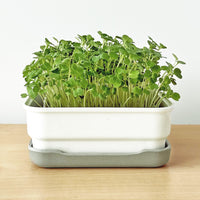
Homegrown microgreens are rich in vitamins, minerals, and phytonutrients that support feather health, digestion, and energy. Grown fresh in your own kitchen, they add colour, crunch, and hydration to daily chop while encouraging natural foraging. With soft stems and leaves that even small birds accept, Micropod makes it simple to rotate fresh greens through the week for balance and variety.

Clean, Soil-Free Growing

Micropod uses natural grow mats instead of soil, keeping benches, windowsills, and cage areas neat. No dirt, no mess, just clean, fresh greens ready for your bird’s diet.

Fast and Reliable Harvests

Seeds germinate quickly and are ready to snip in 8–14 days. A simple cycle of sow, water, and harvest keeps your bird supplied with fresh greens.

Nutritious and Bird-Friendly

Tender stems and leaves are easy for birds to accept, from budgies through to cockatoos. They bring natural texture and hydration to chop while supporting overall health.

Compact and Easy to Grow

With its small footprint, Micropod fits on a sunny sill or kitchen bench. No special lights or equipment required, just water and natural light.

Clean, Soil-Free Growing

Micropod uses natural grow mats instead of soil, keeping benches, windowsills, and cage areas neat. No dirt, no mess, just clean, fresh greens ready for your bird’s diet.

Fast and Reliable Harvests

Seeds germinate quickly and are ready to snip in 8–14 days. A simple cycle of sow, water, and harvest keeps your bird supplied with fresh greens.

Nutritious and Bird-Friendly

Tender stems and leaves are easy for birds to accept, from budgies through to cockatoos. They bring natural texture and hydration to chop while supporting overall health.

Compact and Easy to Grow

With its small footprint, Micropod fits on a sunny sill or kitchen bench. No special lights or equipment required, just water and natural light.

Us vs OTHER BRANDS

We focus on clean, bird-friendly growing that fits real homes. Many kits make a mess or skip bird-specific guidance. Here’s how Micropod at Seed Cube compares

Soil-free, compostable

Even growth

Untreated, non-GMO seeds

Bird-first guidance

Ready in 8–12 days

Refills, spare parts, local AU support

OTHER BRANDS

Soil Free

Mess-Free

Bird Safe

Untreated Seeds

Easy Clean

Aussie Owned

Soil-Free, Fresh, and Bird-Friendly

multicolumns-item-image-1

Clean Soil-Free Growing

Grow microgreens without soil. Compostable jute mats keep roots stable and benches tidy around cages and prep areas.

multicolumns-item-image-2

Weekly Fresh Harvests

Sow, germinate under the lid, then harvest in 8 to 14 days. Stagger trays so your bird’s chop always has fresh greens.

multicolumns-item-image-3

Tender Greens Birds Accept

Soft stems and leaves mix smoothly into chop, easy for budgies, cockatiels, conures and larger parrots.

multicolumns-item-image-1

Clean Soil-Free Growing

Grow microgreens without soil. Compostable jute mats keep roots stable and benches tidy around cages and prep areas.

multicolumns-item-image-2

Weekly Fresh Harvests

Sow, germinate under the lid, then harvest in 8 to 14 days. Stagger trays so your bird’s chop always has fresh greens.

multicolumns-item-image-3

Tender Greens Birds Accept

Soft stems and leaves mix smoothly into chop, easy for budgies, cockatiels, conures and larger parrots.