
Feeding and Diet

What to Feed a Finch: A Complete Diet Guide

By Russell Neale, Founder, Seed Cube 9 min read

TL;DR

  • Finches are passerines, not parrots, so build the diet on a quality millet and canary seed mix rather than pellets alone.
  • Add fresh greens or chopped vegetables every day, plus egg food or sprouted seed through the moult and breeding season.
  • A finch shells every seed, so a dish full of husks is a dish with no food in it. Clear the husks off every morning.
  • Cap seed at about one level teaspoon per bird per day, and give each finch its own dish.
  • Skip insoluble grit. Finches shell their seed, so they do not need it, and too much can block the gut.

Quick answer

Feed a finch a quality small-seed mix of millets and canary seed as the base, fresh leafy greens or finely chopped vegetables every day, and egg food or sprouted seed for extra protein through the moult and breeding season. Add a finch crumble or small pellet to cover the vitamins and minerals seed lacks, keep a cuttlebone available for calcium, and change the water daily. Cap seed at about one level teaspoon per bird per day, clear the empty husks off the dish every morning, and skip insoluble grit.
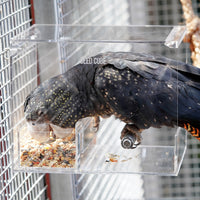
Two zebra finches feeding together, suited to a Small Seed Cube no-mess finch feeder
A finch shells every seed it eats, and that one habit explains most finch feeding mistakes.

What to feed a finch each day

A finch does best on a small-seed base with fresh food beside it every day. Here is the whole diet in one glance.

  • A quality small-seed mix of millets and canary seed as the everyday base. Cap it at about one level teaspoon per bird per day.
  • Fresh leafy greens or finely chopped vegetables every day, in their own dish.
  • Egg food or sprouted seed a few times a week, and daily through the moult and breeding season.
  • A finch crumble or small pellet to cover the vitamins and minerals seed cannot supply.
  • A cuttlebone for calcium, and clean water changed every day.

If you keep more than one finch, give each bird its own dish, or use a dish wide enough for several to feed at once. Finches feed in company, and a dominant bird will otherwise hold the bowl.

Why a full seed dish can be an empty one

This is the most useful thing to understand about feeding finches, and most guides skip past it in a sentence.

A finch does not swallow seed whole. It holds each seed, splits the shell, swallows the kernel and drops the empty husk straight back into the dish. Within a day the bowl can look completely full and hold almost no food. The RSPCA method for measuring how much seed a bird actually eats begins by blowing the husks off the dish first, precisely because the dish lies to you.

That matters more for a finch than for a parrot. A finch weighs 10 to 16 grams, burns energy quickly for its size and carries almost no reserve. A bird this small goes downhill in hours rather than days, and it will hide the fact until it is nearly too late.

The same habit causes two more problems that almost nobody connects to it. Vitamin-coated seed loses most of its coating with the shell, so a fortified mix largely fortifies the bin. And powdered supplements sprinkled over dry seed end up in the bottom of the dish with the husks, which is why vets tell you to put powders on moist food instead.

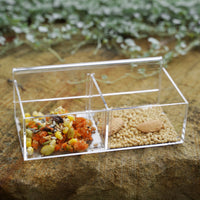
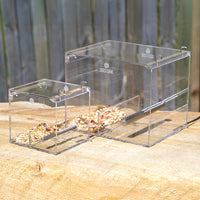
Fix the husk and you fix all three. Tip or blow the husks off every morning before topping the dish up, and check that what is left is actually seed. A feeder that keeps husks out of the seed column, rather than letting them settle on top, does the same job with less daily fiddling.

Choosing a finch seed mix, and why seed alone falls short

Seed is not the enemy for a finch the way it is for a lorikeet. Wild finches are grass-seed specialists and a good mix belongs in the diet. The problem is what happens when seed is the entire diet.

Two things go wrong. First, commercial mixes usually hold only a handful of seed types, they run high in fat, and they are not the seeds wild finches actually eat. Second, given a choice, a finch eats its one or two favourites and leaves the rest, so even a varied mix ends up narrow. Millet sprays and honey sticks are the extreme version of this: birds love them, and they deliver very little beyond energy.

Look for a mix built on a range of millets with canary seed, keep it airtight and buy quantities you will get through. Seed goes stale, and stale seed loses what little vitamin content it had.

For scale on the fat question, sunflower seed runs about 49 per cent fat, roughly three times a chocolate bar. Finch mixes are not sunflower-heavy, but the same principle applies to any oil seed that creeps into the bowl.

Greens and vegetables finches will actually eat

Fresh food goes in every day, in its own dish, chopped small enough for a bird the size of your thumb. The RSPCA sorts bird vegetables by colour, which is an easy way to keep variety without keeping a spreadsheet.

  • Green: silver beet, broccoli, peas, beans, dandelion, milk thistle.
  • Yellow: corn, grated carrot, sweet potato, pumpkin.
  • Red: capsicum, beetroot.

Seeding grass heads are the closest thing to a wild finch's natural food, and most finches go straight for them. Only pick from ground you know has not been sprayed.

Fruit is a treat rather than a food group. All fruit is high in sugar, so keep portions tiny and lean towards low-GI options such as apple, pear or kiwi fruit rather than watermelon. Wash everything, and take uneaten fresh food out the same day before it spoils.

Egg food, sprouted seed and live food

Seed and greens do not carry enough protein for a moulting or breeding finch. Growing a full set of feathers is expensive, and a hen producing eggs needs protein and calcium at the same time.

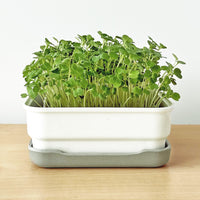
Egg food is the standard answer: a commercial egg and biscuit mix, or hard-boiled egg mashed with its shell and offered fresh for a couple of hours only. Sprouted seed is the other cheap upgrade, since sprouting lifts the nutritional value of the same seed you already buy. Rinse sprouts well and throw out anything that smells sour.

Some finches also take live food such as small mealworms or fly pupae, particularly when rearing chicks, and others largely ignore it. Offer a little and watch what happens rather than assuming.

Through the moult and the breeding season, move egg food from a few times a week to daily. Outside those periods, ease it back, because a constant high-protein diet encourages a pair to keep breeding.

Finch crumbles and pellets, and how to change a finch over safely

Formulated food is where finch advice and parrot advice part company, and it is worth being honest about it.

Vets are clear that seed alone is not a complete diet, and most put formulated food at roughly 60 to 70 per cent of the diet for birds generally. Veterinary guidance for finches specifically is that formulated food should be the bulk of the diet, with fresh produce and a smaller share of seed alongside. Crumbles are the practical format, because a pellet sized for a parrot is no use to a 12 gram bird. Vetafarm Finch & Budgie Crumbles is the extruded crumble we stock for exactly this job.

The catch is conversion. A mature finch raised on seed can be very hard to change over, and a finch has no margin for a hunger strike. Never swap cold turkey.

The RSPCA method works well and is deliberately slow.

  1. Measure what your birds actually eat. Measure the seed in, blow the husks off 24 hours later, measure what is left, and repeat for three or four days.
  2. Offer that same amount of seed, mixed with an equal amount of crumble and thawed mixed vegetables, worked into an even mash so nothing can be picked out.
  3. Take a pinch of seed out each day. Most birds are eating the new food within two to three weeks.

Watch them daily while you do it, and weigh small birds if you can. Small black droppings, or droppings that are all white, mean the bird is not eating. Put seed back immediately, and call an avian vet if it does not pick up within a few hours.

Calcium, cuttlebone and the grit question

Two different products both get called grit, and they do completely different jobs. Confusing them is a common and occasionally dangerous mistake.

Insoluble grit is stone or quartz. Its job is to grind seed in the gizzard for birds that swallow seed whole, such as pigeons and doves. A finch shells its seed before swallowing it, so it does not need insoluble grit at all. Eaten in quantity it can obstruct the gut, and store-bought grit has been implicated as a source of heavy metal exposure.

Calcium sources are a different matter. Cuttlebone, a mineral block or fine shell grit supply calcium, and a laying hen needs a great deal of it. Egg binding in a bird this small is serious and often fatal. Keep a cuttlebone in the cage year round, and make sure it can be reached from a perch.

If you use a powdered calcium or vitamin supplement, put it on moist food. Sprinkled over dry seed it simply ends up in the bottom of the dish with the husks.

Foods never to feed a finch

Keep these out of reach entirely.

  • Avocado.
  • Chocolate, and anything containing caffeine, including tea and coffee.
  • Salty foods such as chips, pretzels and popcorn.
  • Alcohol.
  • Anything cooked with oil, butter or spices.
  • Apple seeds and stone-fruit pits.

Dairy is not toxic, but birds are lactose intolerant, so keep it to a crumb if at all. Plants sprayed with insecticide or herbicide are a real risk with foraged greens and grass heads, so only pick from ground you know.

Key facts

  • 1 level teaspoon

    Maximum seed per finch per day

  • 10 to 16 g

    Typical adult finch weight

  • 49%

    Fat content of sunflower seed

  • 60 to 70%

    Share of the diet vets want formulated food to reach

  • 2 to 3 weeks

    How long a safe seed to crumble changeover takes

  • None

    Insoluble grit a seed-shelling finch needs

Seed layerForage Gourmet Seed - Finch & Canary Specialty Blend-Bird Seed-Seed Cube

Forage Gourmet

Forage Gourmet Seed - Finch & Canary Specialty Blend

$15.99

Our Finch & Canary blend is the quality seed layer for a finch's diet, built on millets and canary seed to pair with daily greens and a finch crumble. Load it into the Small Seed Cube so the husks stay contained instead of settling on top of the seed.

Shop Finch & Canary blend
Forage Gourmet Seed - Finch & Canary Specialty Blend-Bird Seed-Seed Cube
Forage Gourmet Seed - Finch & Canary Specialty Blend $15.99
Shop Finch & Canary blend

Frequently asked questions

What do finches eat?

Pet finches eat a quality small-seed mix of millets and canary seed, fresh greens and finely chopped vegetables daily, egg food or sprouted seed for protein, and a finch crumble or small pellet to cover the vitamins and minerals seed lacks. Add a cuttlebone for calcium and fresh water every day. In the wild they are grass-seed specialists that also take insects, berries and other vegetation when they are available.

How much should I feed a finch each day?

Veterinary guidance is about one level teaspoon of varied seed per bird per day, in a shallow dish, with fresh food offered separately. If you keep several finches, give each bird its own dish or use one wide enough for several to feed at once, so a dominant bird cannot monopolise it.

Why does my finch's seed dish look full but never go down?

Because it is probably full of empty husks. A finch splits each seed, swallows the kernel and drops the shell back in the dish, so a bowl can look full and hold almost no food. Tip the dish into your hand and blow gently each morning. If most of it lifts away, top the dish up with fresh seed. Birds have starved beside a bowl that looked full.

Do finches need grit?

Not insoluble stone grit. That exists to grind seed in the gizzard for birds that swallow seed whole, such as pigeons and doves. Finches shell their seed first, so they do not need it, and eaten in quantity it can obstruct the gut. Calcium sources are different: cuttlebone, a mineral block or fine shell grit are worth offering, especially to laying hens.

Can finches eat pellets, and how do I change them over?

Yes, and a finch crumble is the practical format. Change over slowly. Measure what your birds actually eat over three or four days, then offer that same amount of seed mixed into an even mash with an equal amount of crumble and thawed vegetables, and remove a pinch of seed each day. Most birds are eating the new food within two to three weeks. Never swap cold turkey, and put seed back immediately if droppings turn small and black or go all white.

Can finches eat fruit and vegetables?

Yes, and vegetables should be offered daily. Good options are silver beet, broccoli, peas, beans, dandelion, grated carrot, corn, sweet potato and capsicum, all chopped very small. Seeding grass heads are a favourite and the closest thing to their natural food. Fruit is high in sugar, so treat it as an occasional treat and prefer low-GI fruits such as apple, pear or kiwi fruit.

Is millet spray bad for finches?

Not harmful in itself, but it is close to empty calories. Millet is tasty and short on several essential vitamins and minerals, and honey sticks add fat on top of that. Both encourage a finch to fill up on its favourite and ignore better food. Use them as an occasional treat or a foraging toy, not as a staple.

What foods are dangerous for finches?

Never feed avocado, chocolate, caffeine, alcohol, salty foods such as chips or popcorn, anything cooked with oil, butter or spices, or apple seeds and stone-fruit pits. Dairy is not toxic but birds are lactose intolerant, so keep it minimal. Sprayed greens and grass heads are a genuine risk, so only forage from ground you know. If your finch eats something on this list, ring an avian vet straight away.

Sources

  1. RSPCA Australia KnowledgebaseWhat should I feed my birds? and How should I care for my birds?, the latter authored by Prof Bob Doneley BVSc FANZCVS (Avian Medicine), Registered Specialist in Bird Medicine. Used for the 49 per cent sunflower fat figure, the roughly 60 per cent formulated and 40 per cent vegetable split, the vegetable colour groups, the low-GI fruit guidance, the husk-off method for measuring seed intake, the three-step mash conversion, and the black-dropping warning sign that a conversion has been pushed too hard.
  2. VCA Animal Hospitals, Feeding FinchesVeterinary guidance used for the one level teaspoon of seed per bird per day, separate dishes for each finch, the share of the diet formulated food should reach, the difficulty of converting mature seed-raised finches, daily weighing and dropping checks during a changeover, why finches do not need insoluble grit, the obstruction and heavy metal risks of grit, why powdered supplements belong on moist food, and the never-feed list.
  3. Lafeber Pet Birds, FinchUsed for finches being passerines rather than parrots, the Estrildidae family and its Australasian origin, and the recommended base of formulated food supplemented with greens, vegetables, grubs, egg food and some seed.

About the author

Russell Neale
Founder, Seed Cube

Russell Neale is the founder of Seed Cube, a bird-feeding brand he started in 2024 in the Hills District of NSW. A long-time bird owner himself, with three birds including a 12-year-old hand-raised Alexandrine, Russell built Seed Cube after years of frustration with messy, flimsy and poorly designed feeders.

Seed Cube makes practical, durable products that keep feeding cleaner, easier and safer for pet birds, and that are designed to last rather than end up in landfill. The brand works closely with Hills Wildlife Sanctuary, and everything it makes is BUILT FOR BIRDS™.

Feed a finch like the small seed-eating passerine it is: a millet and canary seed base, fresh greens every day, egg food or sprouted seed through the moult and breeding season, and a finch crumble to cover what seed cannot. Keep a cuttlebone available, change the water daily, and clear the husks off the dish every morning.

Want the husks contained rather than scattered? See the Finch Feeder, or read the full Finch Care Guide for housing, flock size and health.

Shop the Finch Feeder